Thursday, August 18, 2016
Don't You Cry By Mary Kubica
This is Kubica's third mystery thriller. In downtown Chicago, Quinn is woken at 6:30am by her flatmate's alarm, but Esther is nowhere to be found. It is only after about 24 hours that Quinn starts to get really worried. Meanwhile, 18-year-old Alex is working as a busboy at a small town diner, having turned down a college scholarship to take care of his alcoholic father.
The chapters switch between Quinn and Alex. It is not until the last 40 pages that the author reveals what has happened to Esther and how it connects to Alex.
I really enjoyed the book. I thought I knew what the big reveal was going to be but I was way off the mark. Both Alex and Quinn are multi-dimensional characters; neither being particularly likeable, but they grew on me. This is the first book I've read by the author but based on reviews Kubica is getting better with each book.
Wednesday, August 10, 2016
Truly Madly Guilty by Liane Moriarty
Erika and her husband Oliver are both a little odd. Cellist Clementine, Erika's best friend since childhood, and Clementine's husband Sam, endure rather than enjoy Erika and Oliver's company.
Erika and Oliver's neighbours, Vid and Tiffany, are both extroverts and have little in common with them. However, Vid and Tiffany met Clementine and Sam at a Christmas party, and really enjoyed their company. When Erika mentions to Vid that Clementine, Sam, and their two girls are coming over for afternoon tea, Vid suggests they all join him and his family for a barbecue.
The story revolves around the barbecue; the chapters switch from the present day (two months after the barbecue) to the day of the barbecue. Something dreadful happened that has left Erika with memory loss and Clementine and Sam struggling to keep their marriage together.
It takes 300 pages to find out what happened at the barbecue. There are a couple of other 'reveals' in the last 200 pages but nothing particularly surprising. The beauty of the book is not so much a clever plot but the building of the characters. Moriarty expertly paints a picture of ordinary people who may at first seem unappealing but who are, on the whole, doing their best under the circumstances.
The book explores themes of friendship, marriage and how life changes after parenthood. Erika and Clementine's friendship, Sam and Clementine's marriage, and Erika's relationship with her mother, all reveal how feelings of love and hate are sometimes hard to separate.
Sunday, July 10, 2016
Unidentified Suburban Object by Mike Jung
Grade 8 student Chloe Cho is the only Asian student at her American K-8 school. She is tired of people assuming she is a high achieving student and excellent violinist simply because she is Asian. She is tired of people thinking she is either Chinese or Japanese, when she is in fact Korean. She is tired of her parents refusal to tell her anything about Korea; they don't talk about it, they don't eat the food and they don't even recognise the clothing. She is however, excited to find her new Social Studies teacher is Korean.
When Chloe finally finds out her parents' secret she stops completing assignments, falls out with her best friend Shelley, and ends up in detention. The secret is not what Chloe was expecting and not what I was expecting. The book takes something of a comic turn but still does a good job of exploring identity, friendship, belonging and racial stereotyping. Chloe and her family feel like foreigners in both Korea and America.
Discussion Questions from Scholastic
- Why does Chloe feel like an alien at school and in her town?
- In which ways does Chloe try connecting with her heritage? How have you connected with your heritage? Share an example.
- Why is Chloe so excited about her new history teacher, Ms. Lee? In which ways does Ms. Lee influence Chloe?
- Which scene from the book do you remember best? What makes it so memorable?
- Discuss Chloe’s friendship with Shelley. How does it evolve over the course of the story?
- Explain how the truth behind her parents’ heritage changes Chloe’s perception of herself. How would you feel if you were in her position?
- Chloe and Shelley work together to participate in their town’s first annual Graphic Novel-Making Contest! If you created a graphic novel with your friends, what would it be about?
- What is your family ancestry? Did your relatives emigrate from another country? If so, from where? And what was their life like there?
- Did you ever find yourself disagreeing with a character’s choice? What did they do? What would you have done differently?
- What surprised you most about the story? What did you learn from reading this book?
Discussion guide here
Thursday, July 7, 2016
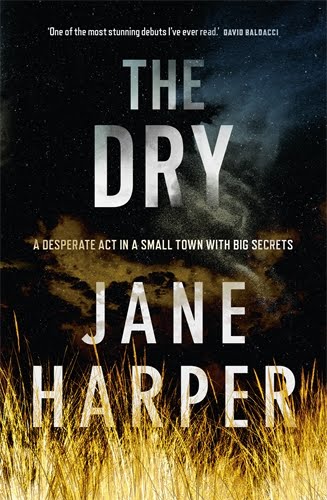
The Dry by Jane Harper
This is a fabulous crime mystery; it reminded me of both The Dressmaker and Gone Girl, but a simpler story.
Melbourne based Federal Police investigator Aaron Falk returns to the small outback Australian town of his childhood for the funeral of his farmer friend Luke and Luke's family. It appears that Luke killed his wife and son before turning the gun on himself after struggling financially due to a two year drought. Luke's father is convinced it wasn't suicide and asks Aaron to investigate. Aaron works with a local police officer to uncover what happened.
Aaron has not been back to Kiewarra since he and his father fled town, after his friend Ellie drowned and her father pointed the finger at sixteen year old Aaron. The book slowly reveals not only what happened to Luke and his family but also Ellie. I found the characters interesting and believable; some have lived their lives in Kiewarra while others moved there with misplaced romantic notions of what rural life would be like. Like any good crime novel, information is revealed gradually throughout the book; it doesn't all happen in the last fifty pages. That said, the last fifty pages are riveting.
Tuesday, July 5, 2016
When you reach me by Rebecca Stead
This children's book won the Newbery Medal in 2010. It is written in the first person by the protagonist, Miranda, and is addressed to a person unknown. The story is set in 1979, a time when most children walked home from school. Miranda is 12 years old and is helping her mother prepare for an appearance on a TV quiz show that will hopefully earn them some much needed money. Miranda always carries a copy of her favourite book, Newbery Medal winning (1963), A Wrinkle in Time by Madeleine L'Engle. She discusses the book with a new boy at school, Marcus, who appears to be something of a genius.
Miranda begins to get strange notes from the person she addresses the book to. The writer of the notes appears to know things that haven't happened yet. Miranda has been lifelong friends with her neighbour Sal, but he's started to act distant. Miranda forms new friendships with Annemarie and Colin; the three of them start to work at lunchtime in a cafe called Jimmy's. The area Sal and Miranda live in is rough. There are frequent fights and a strange old homeless man stands on the corner of the street and kicks the air.
I got a bit bored with the story in the middle (when Miranda is working at Jimmy's), but it all comes together in the last forty pages when we find out who is writing the notes. The ending made me want to go back and read the book again from the beginning. This would be a great book to read to a Stage 3 class as it explores the way friendships shift and change. There are plenty of teaching resources to go with the book on TPT and other sites.
Questions
What was the significance of the $2 notes?
What was the purpose of the notes Miranda received?
Was Miranda's life altered by what happened to Sal? (think about the TV quiz show).
Why were the notes so cryptic, why not just say what was happening?
In what way does the character of Julia break racial stereotypes?
How does Miranda make new friends?
What does the author want us to learn from the story of Miranda's mother?
Based on the book, how does childhood in 1979 differ from today?
Writing
Miranda looks under the mailbox and finds a final letter explaining what happened to the author of the notes after 1979. Write the letter.
Saturday, July 2, 2016
Apple Tree Yard by Louise Doughty
Dr Yvonne Carmicheal is a well respected scientist and academic, in her early fifties, with two adult children, and married to another scientist. She locks eyes with a stranger and, for some reason, is happy to go off and have sex with him in a broom closet in the crypt of the Houses of Parliament. The affair, and the man's penchant for public places, continues until something goes dreadfully wrong. The story begins with Yvonne and the fling, both on trial at the Old Bailey. The story slowly reveals what happened, who the man is, and how they got to be on trial.
Yvonne's marriage has had it's difficulties, but I can't say that helped me feel any sympathy. The 'thing that goes dreadfully wrong' did increase my empathy for her. The second half of the book becomes a courtroom drama. I read it quickly and wasn't disappointed with the ending. Yvonne, her lover and her husband all have a mix of positive and negative traits that provide plenty to reflect on.
Some readers might see the moral of the story as being about women being judged by different standards to men, but for me it was that smart middle aged women, who think they've moved beyond the foolishnesses of youth and the hoi polloi, are just as capable of making idiots of themselves as anyone else.
Thursday, May 19, 2016
The Natural Way of Things by Charlotte Wood
![]() |
| The Natural Way of Things |
I don't usually include spoilers, but I think it's unavoidable with this book. The story is about ten 'celebrity sluts' (girls who have been involved in high profile sex scandals or rape cases) who are abducted and held together in an Australian outback sheep station surrounded by a high electric fence. Two men, Teddy and Boncer, have been paid to guard and feed the girls and put them to work. The girls have their heads shaved and are forced to wear dirty old fashioned clothes. As food runs out, and whoever hired Boncer and Teddy fails to show up, both the men and the girls realise they're all likely to die.
The book is reminiscent of Lord of the Flies, the girls coping with their captivity in different ways. One girl hunts and skins rabbits for the others to eat, one looks for mushrooms in the hope of poisoning the men, three girls take to grooming and depilating each other. What is striking about all the girls is the things they miss. Rather than talking about their families or loved ones, they obsess about their Chloe boots and their clothes.
The book is obviously allegorical and has a message (I resisted using Google to find out what that is). I suspect the book is a parody of a celebrity reality TV show that I haven't watched. Perhaps its purpose is to make the reader appreciate all they have. Alternatively, the purpose may be to remind the reader that not everyone has those things and that in some parts of the world women are treated like slaves. The hero of the story, if there is one, is the hunter. She finds her animal self and a level of happiness. She doesn't personify the qualities that are normally admired in women. She is not kind, or gentle or caring. She is strong, efficient and practical.
I enjoyed the story even if I couldn't relate to any of the characters. Mushroom picking Verla, was perhaps the one I could most sympathise with. I couldn't see why the girls didn't work together and overpower the men, but maybe that's the point of the story; how bizarre it is that women let men treat them the way they do and how much more we could achieve if we supported each other.
Subscribe to:
Posts (Atom)